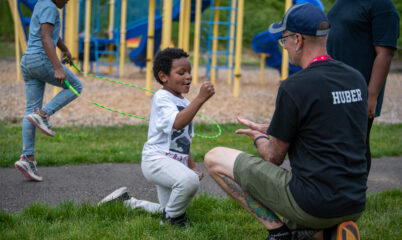
The New York Times article, “Forget Goofing Around: Recess Has a New Boss” has inspired a lot of comment and generated a lot of attention for Playworks. The article raised a provocative question: what's better, structured or unstructured play? To me, the answer is easy: neither. You see, characterizing what we do and what we believe is needed in schools across America as either structured or unstructured is a false choice. Let me explain.
Over the past 14 years, Playworks has provided coaches at hundreds of low-income elementary schools in an effort to ensure that opportunities for play were protected. When I was growing up in Washington, DC, I had the chance to play outside, unsupervised, every day after school, during the weekends and all summer long. While some people might call that play "unstructured," I would argue that it was as structured as anything I have ever been a part of. The older kids taught the younger kids a host of rules – from how to pick teams to how to quickly end disputes – and as the younger kids became the older kids, we passed on this culture of play to the generation behind us.
But kids don’t get to play outside and be unsupervised the way we used to. And so when kids come to school, they don’t bring those skills with them, and recess is fundamentally different from the way you remember it. At Playworks, we aren’t creating opportunities for structured play as a way to control kids. We’re introducing a structure that the kids can ultimately take responsibility for themselves. We’re employing play as an opportunity for kids to develop the skills and to have the experiences they need to be successful: teamwork, empathy and leadership.
Schools all over the country have elected to reduce or eliminate recess because it impinges on instructional time or feels unsafe. Playworks has been growing nationally because schools have found that we can help make it possible for kids to play together and have fun, giving them an alternative to reducing or eliminating recess. Building a culture of play has positive impacts on the school learning environment – both on the playground and in the classroom. I was struck by the extent to which school staff commenting on the article understand and were quick to acknowledge this circumstance, while our detractors were equally quick to assume that our aim in creating structure was somehow nefarious.
I’ve spent the last 14 years of my life getting people to take play seriously and yesterday was a big day. As the ninth most emailed article on the New York Times website, it felt like we had arrived. But I guess I was also a little saddened to see that with this acknowledgement of import, play got sucked into the polarized environment of what passes for “debate” on education. Making sure that play is a part of every child’s day is a cost-effective and common-sense approach to addressing kids’ developmental needs. Bullies are a bummer wherever you find them, and we’re going to keep on doing what’s best for kids, both on the playgrounds and now on the front page of the New York Times. Game on.