Keep Playing: Core Recess Games
Playworks wants to help your school build a culture of play!
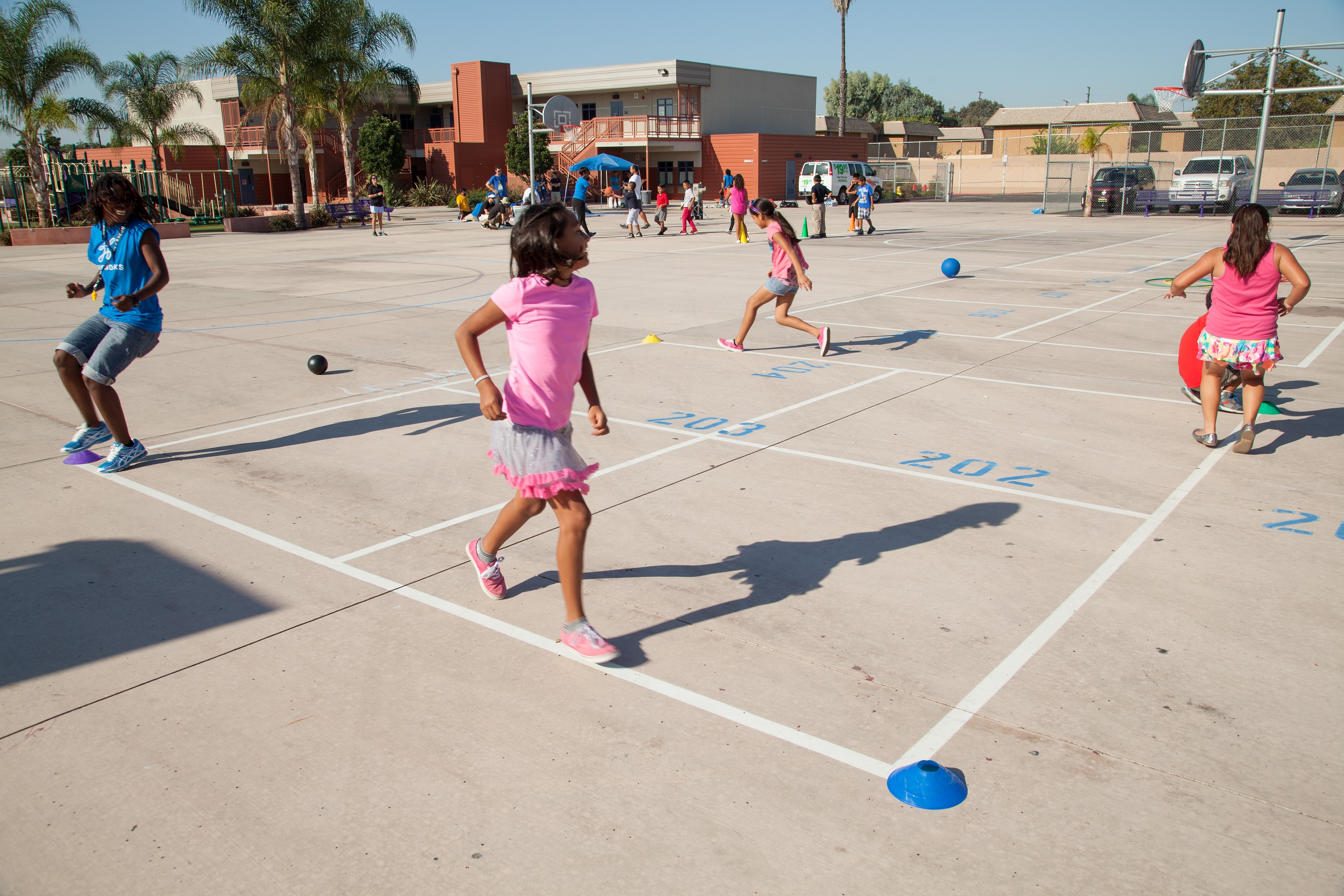
In addition to our Keep Playing Game of the Week, we’re sharing bi-weekly Core Recess Games that will help kids be active, practice leadership, maximize recess time, and have fun.
What is a core game ?
- Occurs in the same place every day
- Clear, defined, visual boundaries
- Defined rules that are known by all
- Has a rotational component
- Largely student-sustained
- Accessible to all skill levels
Ready to play? Learn a new core recess game every other week!
Game 1: Switch
Game 2: Scramble
Game 3: Foursquare
Game 4: Blocker Ball
Game 5: Bandage Tag
Game 6: Sharks & Minnows
Game 7: Three-Lines Basketball
Game 8: Human Roshambo
Game 9: Roshambo Relay
Game 10: Three-Line Soccer
Game 11: Interception
Game 12: Ultimate Ball
Game 13: Basketball Hot Spots
Game 14: Knockout
Game 15: Sprout Ball
Game 16: Watch Your Back Tag
Game 17: Multiball
Game 18: Jump Rope School
Game 19: Cat and Mouse
Simplified Game Instructions
# of people to play: 6-12
Best for ages: 5+
Setup: A foursquare court or four cones forming a square and one additional cone in the middle
Equipment needed: 5 cones or a foursquare court (made with paint, chalk or tape)
Goal: Try to arrive at a different corner/cone of the 4-Square court before other players.
Before you start
- Review the four corners/cones that students can run to.
- Review how to play RoShamBo (Rock Paper Scissors).
How to Play
- Have one player occupy each of the 4 corners and the middle of a foursquare court. A total of 5 players starting at a time.
- Play begins when the person in the middle says the magic word, “Switch” while simultaneously raising both hands in the air and making a clapping sound.
- Once the magic word is announced, all players (including the player in the middle) must find a new corner/cone to occupy. Players cannot go to the cone in the middle.
- At the end of the round, there will be one player left without a corner/cone. That player must go to the end of the line.
- The first person in line becomes the player in the middle and begins the next round.
- If two players arrive at a corner at the same time, they play a round of RoShamBo. The winner stays in the game and the less successful person goes to the end of the line.
Game Variations
- Add more areas the players can run to
- Start a large game of switch by having two players occupy each of the 4 corners and the middle of a 4-square court. A total of 10 players starting at a time.
- Use 4 different colored hula hoops. Have the player in the middle call out a color that signals the players to run/switch. The player in the middle, runs to the color that she/he called aloud. All other players must switch hula hoops, but may not run to the color that was called out.
Simplified Game Instructions
# of people to play: 5+
Best for ages: 5+
Setup: Find or create foursquare court
Equipment needed: A foursquare court (made with paint, chalk or tape)
Goal: To avoid getting tagged.
Before you start
- Demonstrate safe tagging: light/ two finger touch, like a butterfly’s wings, on the shoulder, back, or arms.
- Review how the different roles move:
- Chefs (taggers) – only on the lines
- Eggs – anywhere within the foursquare court
How to Play
- Have one player stand on each corner of the foursquare court. These four players are the Eggs.
- Eggs can move anywhere within the four square court. One player stands in the middle of the foursquare court, this is the Chef.
- They can move only along the lines.
- To start the round, the Chef holds up one arm, and counts down, “3, 2, 1, Scramble!”
- Eggs try to all get together in one small square, while avoiding being tagged by the chef.
- Chef attempts to tag an Egg, while staying on the lines of the foursquare court.
- The round ends if:
- The Chef successfully tags an Egg, the Egg returns to the recycle line, and gets a high five. The Chef becomes an Egg during the next round, and the new player starts as the Chef
- Eggs all get together into one square before anyone is tagged, and exclaim, “Eggs!” Then the Chef will go back in line, and get a high five, and a new player will step out to become the Chef.
Game Variations
- Have more students be eggs at one time, making it easier to tag someone.
- Have the eggs strategize together before the round starts to encourage teamwork. Use a larger four square court if possible.
Simplified Game Instructions
# of people to play: 4+
Best for ages: 6+
Setup: A 4-Square court with each box labeled A, B, C, D or 1, 2, 3, 4.
Equipment needed: rubber ball
Goal: Try to hit the ball in another player’s square without getting recycled out of the game.
Before you start
- One player starts in each square and the other players wait in line for their turn.
- The player in square A or 1 is the server. That player begins the game.
How to Play
- Play begins when the server drops the ball once into his/her square then hits it underhand into a different square.
- The ball must bounce once and only once in any square.
- Each player must hit/play the ball with his/her hand(s) into an opposing player’s square after it has bounced only once in their square.
- Anytime a player gets recycled out of the game, a square is left open and players must rotate. The first person waiting in line advances to square A or 1, and the remaining players advance to close the gaps between A or 1 and D or 4.
- A player goes to the end of the line (gets Recycled out of the game) if any of the below happen.
Recycled If:
- The ball bounces more than once in a player’s square.
- The ball is played before it bounces once in a square.
- The ball hits the inside or outside lines of the 4-square court or goes out of bounds before it bounces, then the player who hit the ball gets recycled out of the game.
- If a player catches, holds, or bubbles the ball
Game Variations
- Allow less skilled players to catch the ball before releasing it into another player’s square.
- Jackpot: A player says “Jackpot” then places the ball in the center of the 4-square court. The last person to put their hand on the ball gets recycled out of the game.
Simplified Game Instructions
# of people to play: 8+
Best for ages: 5+
Setup: Four cones in a square formation or utilize a four square court
Equipment needed: Cones, a playground ball
Goal: Work with your teammate to prevent the ball from rolling across your goal line.
Before you start
- Make sure players understand:
- They must keep at least one foot on their goal line or they must go to the end of the line.
- They may only hit the ball with their hands.
- The ball must remain on the ground.
How to Play
- A player goes to the end of the line (gets Recycled out of the game) if any of the below happen.
Recycled If:
- Players form a line outside the square (recycle / waiting line)
- The first two players become a team and go to one side of the square.
- The second two players form a team and go to the next side, and so-on until there are four teams, one on each side of the square.
- Play begins when the ball is tossed into the air and the ball bounces three times while players yell “Blocker Ball!”
- Each team is responsible for protecting their goal, which is the length of their side of the square, by blocking the ball and rolling it towards an opponent’s goal line.
- When a ball passes over a goal line, that team goes to the end of the line and the scoring team earns a point.
- When a team reaches five points they go to the end of the line.Teams are not meant to stay the same throughout the game. Players should mix up as the return for their second, third, fourth (and so on) turns.
Game Variations
- Make boundaries smaller or larger to decrease or increase the difficulty level.
- To include more kids, increase the number of players per team.
Simplified Game Instructions
# of people to play: Large Group (6+)
Best for ages: 5+
Setup: Designate a clear playing area large enough for the group size. Designate a care zone outside the play area using cones or chalk.
Equipment needed: Cones or chalk to mark the play space boundaries and the care zone
Goal: Try to tag others while avoiding getting tagged yourself.
Before you start
- Demonstrate safe tagging: light/ two finger touch, like a butterfly’s wings, on the shoulder, back, or arms.
- Review what to do when you get tagged. Players go to the care zone to heal themselves after being tagged.
- Review where the care zone is and how to heal yourself.
How to Play
- Everyone is it! Players can tag others and be tagged.
- If a player gets tagged, they must place one hand directly in the area they were tagged. Their hand is a bandage.
- Players can continue running around once they’ve been tagged, trying to tag others while avoiding being tagged themselves. However, they must keep their bandage on and only tag with their free hand.
- If a player gets tagged a second time, they must take their other hand and place it in the area where they were tagged. Players can still continue to run around with two bandages on.
- If any player is tagged a third time, they must go to the care zone and do 6 jumping jacks (two jumping jacks per bandaid) or another predetermined action to get back in the game.
Game Variations
- Allow players to go to the care zone at any time to heal themselves. They do not have to wait until they are tagged the second or third time.
- Allow players to heal themselves by stepping anywhere outside the boundaries to do jumping jacks or any other predetermined action.
- Modify the player’s movement in the game by trying different footwork, such as walk like a zombie, hop like a bunny, move like you are walking through glue, or skipping.
Simplified Game Instructions
# of people to play: Large Group (10+)
Best for ages: 5+
Setup: Designate a clear playing area large enough for the group size. Use cones to designate play space.
Equipment needed: Cones, or another way to mark play space boundaries
Goal: To cross from one side of the play space to the other without getting tagged.
Before you start
- Demonstrate safe tagging: light/ two finger touch, like a butterfly’s wings, on the shoulder, back, or arms.
- Review what to do when you get tagged: turn into a tagger.
- Identify one or two players to begin as the tagger (shark). Everyone else will be the runners (minnows).
How to Play
- The shark(s) stands in the middle of the play area and says,”Fishy, fishy, come out and play.”
- The minnows begin running towards the opposite side of the play space, trying to avoid getting tagged by a shark.
- If a minnow is tagged, they also become a shark.
- Once all minnows have either made it to the other side, or been tagged and turned into sharks a new round begins.
- When there are only one or two minnows left, they become the sharks in the next round.
Game Variations
- When players get tagged, have them freeze and turn into “seaweed.” They cannot move, but can tag minnows if they run close by.
- Have minnows run back to the starting line when “Shark Attack!” is called, instead of running all the way across the space.
- Use different animal relationships, such as bear and salmon.
Simplified Game Instructions
# of people to play: Large Group (10+)
Best for ages: 8+
Setup: Place three cones in a safe space near a half court basketball court.
Equipment needed: A basketball, basketball hoop, and three cones.
Goal: Be the first team to make a basket within two minutes.
Before you start
- Explain the basic rules of basketball.
How to Play
- Divide players into three groups. Each group should stand in a single file line behind their designated cone.
- The first player in each line steps forward past the cone turning and facing the lines, forming a team of three. This is the defensive team.
- The second player in each line steps forward past the cone, forming a second team of three. This is the offensive team, and will start with the basketball.
- Other players in line wait their turn to play while cheering for the teams that are playing.
- The two teams play a half court game, with the goal of being the first team to score a basket.
- The first offensive player, behind the middle cone, starts with the ball and passes to one of their teammates to start the game.
The Following Rules Apply
- If a player shoots and misses, either team can rebound the ball and shoot again immediately.
- When a point is scored:
- The team that made the basket stays on the court, and starts the next round on defense
- The less successful team returns to the end of one of the lines.
- The next three players in line step onto the court to form a team. This new team starts with the ball and passes to one of their teammates to begin the next round.
- If a foul is called, the player who has been fouled gets to throw the ball in from out of bounds.
- After a set time frame (such as 2 minutes) if a point has not been scored, have players waiting in line count down from ten, nine, eight, etc. At zero: The last player holding the ball takes a free throw shot. If the player makes the shot, their team stays on the court. If the player misses, their team returns to the end of the line, and the other team stays on the court.
- If a team wins three times in a row, they have earned three claps and return to the end of their line to allow others to have an opportunity to play.
Game Variations
- Players must pass the ball to every teammate before they score.
- If three collective shots are missed, have players waiting in line begin the countdown.
- Allow players to choose a different cone to line up behind if their team is less successful.
Simplified Game Instructions
# of people to play: 6+
Best for ages: 5+
Setup: Designate a clear playing area large enough for the group size.
Equipment needed: Cones for boundaries, if necessary
Goal: Collaborate with your teammates to be the most successful team in Ro Sham Bo.
Before you start
- Divide the players into two teams
- Review how to play Rock Paper Scissors
- Review the body movements that represent each element
- Rock – Crouched low in a ball shape
- Scissors – standing with legs apart and arms stretched wide overhead
- Paper – standing with legs together and arms together overhead
- Demonstrate safe tagging: light/ two finger touch, like a butterfly’s wings, on the shoulder, back, or arms.
How to Play
- Each team starts at opposite ends of the play space. With backs turned to their opponents, the teams have 10 seconds to silently pick their element: Rock, Paper, or Scissors
- When teams have made their choice, players line up shoulder to shoulder in the middle of the play space, across from the opposing team
- Players all chant “Ro! Sham! Bo!” and on “Bo” both teams jump in the air and land in the shape of their chosen element.
- The team that is more successful then tries to tag their opponents before they make it back to their end of the play space.
- If a player is tagged they join the tagging team.
- When all players have either been tagged or reached their end of the play space, teams regroup and decide what element they want to display in the next round
- Repeat this until all players are on one team, or time is up.
Game Variations
- Have players say their chosen element as well as showing the shape.
- Skip the tagging and just play until a team reaches the desired number of successful rounds.
Simplified Game Instructions
# of people to play: Large Group (6+)
Best for ages: 6+
Setup: Create a semi circle (U shaped) path using cones or use half of a basketball court.
Equipment needed: None
Goal: Player(s) from either team must attempt to make it to the start of the opposite team’s line.
Before you start
- Divide players into two teams. Each team will line up in a single file line behind both ends of the semi circle.
- Review how to play Rock Paper Scissors.
How to Play
- To start the game, all players chant “Ro-Sham-Bo.” On “Bo” the first players from each line begin walking, skipping, or running on the “U” shaped path towards each other.
- When the first two players from opposite teams encounter each other on the path, they stop and RoShamBo until one player wins.
- The winner continues walking on the path in the same direction while the player on the opposite team starts moving on the path towards the winner. Simultaneously, the less successful player must return to the end of their line.
- When both players encounter each other they must Roshambo again until one player wins. This continues until a player makes it all the way to the start of the opposite team’s line.
- Once a player makes it all the way to the opposite team’s side, that player rejoins the end of his/her line and two new players begin moving along the path.
Game Variations
- Add obstacles to the path.
- Make the path longer/shorter or utilize a different shaped path.
- Tally scores by giving one point to the team whose player makes it from one side to the other.
- Give players a category to name one thing from as they meet in the middle. For example, each player has to yell out the name of a fruit or vegetable, natural environment, a state, etc. before they Roshambo. This variation is great for teachers who want to reinforce class learning in an active way.
Simplified Game Instructions
# of people to play: Large Group (9+)
Best for ages: 6+
Setup: Designate a clear playing area large enough for the group size. Place three cones along one sideline of the field. If soccer goals are not available, create them with two cones on either side.
Equipment needed: soccer ball, 3 cones, and 2 soccer goals
Goal: Be the first team to score a goal within two minutes.
Before you start
- Explain the basic rules of soccer.
How to Play
- Divide students into three groups. Each group should stand in a single file line behind their designated cone.
- The first player in each line steps onto the field and forms a team of three.
- The second player in each line steps onto the other side of the field and forms a team of three.
- One player from each team plays a round of Rock Paper Scissors to determine who will kick off.
- Other players in line wait for their turn while cheering for the teams that are playing.
- The object of the game is to be the first team to score a goal.
The following rules apply:
- When a point is scored, the winning team stays on the field and the less successful team returns to the end of their line.
- The next three players in line step onto the field to form a team. This new team gets to kick off the ball.
- After a set time frame (such as 2 minutes) if a point is not scored, both teams must return to the end of their lines.
- If a team wins three times in a row they have earned three claps and must return to the end of their line to allow other players to have a chance.
Game Variations
- Players must pass the ball to every teammate before they score.
- Allow players to choose a different cone to line up behind if their team is less successful.
- Play with just one goal. Teams who steal the ball while on defense must pass the ball one or two times before they can score.
Simplified Game Instructions
# of people to play: Large Group (6+)
Best for ages: 7+
Setup: Open area appropriate for the size of players and throwing skills. Create a goal line with cones.
Equipment needed: Football(s) and cones
Goal: The receiver must attempt to score by catching the football and making it to the end zone without getting tagged by the defender.
Before you start
- Create a “goal line” and set up three cones for students to line up behind on the opposite end of where the goal line is.
- Explain the three main positions of the game: Quarterback, Receiver, and Defender.
- Quarterback: Player who throws the ball to the receiver.
- Receiver: Player who is attempting to make a catch from the Quarterback and score a “touchdown”
- Defender: Player who is trying to stop the Receiver from making a catch, by either swatting the ball or butterfly tagging the Receiver before they cross the goal line.
- Explain the rotation of the positions after a play ends..
- QB will go to the end of the Receiver line.
- Receiver will go to the end of the Defender line.
- Defender will go to the end of the QB line.
- Demonstrate safe tagging: light/ two finger touch, like a butterfly’s wings, on the shoulder, back, or arms.
Optional: Use flag football flags and belts. This will eliminate the need for tagging.
How to Play
- Have all players line up evenly behind one of the three cones.
- Tell the players which position each line represents.
- The first player in each line steps into the playing area to begin the game.
- The Quarterback will start with the ball. When they say hike, the receiver runs toward the goal line and is attempting to make a catch. The defender is trying to prevent the receiver from catching the ball.
- The quarterback is trying to throw the ball to the receiver so that she/he can catch it and run past the goal line to the end zone (the scoring area) without being tagged.
- The round of play ends, if:
-
- The ball drops
- The defender catches the ball
- The defender tags the receiver
- The receiver scores
- Once the round of play is over, the player who was the QB will go to the end of the receiver line. The receiver will go to the end of the defender line and the defender will go to the end of the QB line.
- The next person in each line steps forward into the playing area to start the new round.
Game Variations
- Have more than one receiver and defender.
- Allow handoffs as well
- Apply the game to basketball with the positions of point guard, forward, and defender.
Simplified Game Instructions
# of people to play: 6+
Best for ages: 8+
Setup: Designate a clear, rectangular playing area large enough for the group size. Use cones to set up an end zone at each end of the playing area
Equipment needed: Medium-sized ball, cones
Goal: Be the first team to catch the ball in the end zone.
Before you start
- Divide players into two teams.
- Explain that when a team has control of the ball, they are on offense, trying to score a point. When they do not have control of the ball they are on defense, trying to block the other team and regain control of the ball.
- One player from each team plays Rock-Paper-Scissors to determine which team will start on offense.
- Teams start lined up in each end zone.
How to Play
- A player from the team starting on defense begins the game by throwing the ball to the team on offense.
- One player from the offense either catches the ball or picks it up where it lands, and tries to pass it to one of their teammates.
- Players cannot take steps or run when they have the ball, and must try to pass it to a teammate.
- The offense tries to advance the ball down the field with passes, and scores a point if one of the team members catches the ball in the end zone.
- The defense tries to block or knock down the ball when it is passed to gain possession. If a ball is knocked down or intercepted, play of the game is switched and the defense now becomes the offense, heading toward their end zone.
- Players may not touch each other, even while playing defense and must keep a safe distance from the player with the ball.
Game Variations
- Allow players to take one or two steps when passing the ball.
- Use different colored jerseys to differentiate teams.
- Change the ball to a football, making it a lead-up game to Football
- Change the ball to a frisbee for more skilled players
Simplified Game Instructions
# of people to play: Small group (4+)
Best for ages: 5+
Setup: Place 1-4 cones (depending on the number of players) at about half court on a basketball court. Scatter roughly 20+ poly spots or half cones all around in front of the basketball hoop.
Equipment needed: Basketballs and poly spots/half cones
Goal: Players have one attempt to make a shot from a poly spot into the basketball hoop.
Before you start
- Create teams by having players line up behind the cone(s), facing the basketball hoop.
How to Play
- One player at a time from each team dribbles the ball to a poly spot, stands on the spot, and attempts to make a shot into the basketball hoop. Players only get one try to make a shot.
- If a player makes a shot, they pick up the poly spot and retrieve the ball. They bring the poly spot back to their team, place the spot in a pile next to their cone and pass the ball to the next player in line, who then dribbles to their own spot and attempts a shot.
- If a player misses the shot, they leave the poly spot, retrieve the ball, and pass it to the next player in line.
- Play continues until all the spots are claimed.
- Once all spots are claimed, players can count how many points they made. One point per poly spot.
Game Variations
- Allow players to take a second shot if they miss.
- For more advanced players, place spots further away from the basketball hoop and make more difficult shots worth more points.
- If basketball hoops are too high for younger players, try placing a hula hoop on the rim against the backboard and allow players to score by throwing the ball into the hula hoop.
Simplified Game Instructions
# of people to play: 2+
Best for ages: 8+
Setup: Have the free throw line clearly marked and 2 basketballs
Equipment needed: two basketballs, one hoop, a marked free throw line
Goal: To make a basket before the person behind you does.
Before you start
- Have the free throw lines clearly marked.
- Have 2 basketballs pumped and ready to go.
- Game is best if it is around 6-10 players per hoop. So you might need multiple setups for an entire class or big recess.
How to Play
- All players line up at the free throw line, with the first two players starting with a basketball.
- Whoever is first in line gets to shoot the ball from the free throw line and then the person behind them can shoot as soon as it is released from the first player.
- If the first shot is missed, that player can then shoot from anywhere and they have to make a basket before the person behind them makes a shot.
- If the first person makes a shot they then pass it to the next person in line but if the person behind them makes a basket before they do they are out.
- The game is an elimination game until only one person is left. The last shooter to survive becomes the winner of Knockout and starts the next round.
Game Variations
- Ro-Sham-Bo Knockout: If you get out you can Ro-Sham-Bo-with the next player who gets out to get back in the game.
- Superstar Knockout: 3 players will shoot at the same time. 2 lines are at each side of the court and 1 line is in the middle. The middle line is marked with a star and designated as the superstar spot. The two lines on the sides will have teams. Whoever wins the knockout round of the 3 players gets to shoot again at the superstar spot for next round, if you don’t win you go to the end of your team line.
- Medic Knockout: If a designated medic makes a free throw he gets to save everyone who is out and bring them back into the game.
Simplified Game Instructions
# of people to play: Small group (5+)
Best for ages: 7+
Setup: Use a large play area with clear boundaries appropriate for the number of players.
Equipment needed: Soft Playground Balls/Dodgeballs
Goal: Be the last player standing by avoiding getting hit with the ball from the waist down.
Before you start
- Review appropriate places to hit with the dodgeball (below the waist or it doesn’t count) and dodgeball safety by throwing the ball gently.
How to Play
- Have players start on one of the boundary lines of the play space with all but one ball scattered throughout the play space.
- The remaining ball is tossed into the air and players must wait for the ball to bounce three times before they can move to try and pick up a ball.
- Once a player has a ball they have 5 seconds and up to three steps to throw the ball towards another player and try to tag them from the waist down.
- If a player gets hit below the waist or tries to catch the thrown ball and drops it, they become a “seed” by crouching down or taking a knee exactly where they were hit. Students with limited mobility can put hands on knees or use another adaptation.
- If a player catches a thrown ball, the player who threw the ball becomes a seed instead.
- Seeds should remember who tagged them because they can “sprout” up and keep playing when the person who tagged them is tagged.
- Play continues until all of the players have been tagged by the same player, or time runs out.
- In the event that a ball goes out of bounds, one student will retrieve the ball and begins by taking three steps as soon as they step back in bounds with the ball.
Game Variations
- This game can also be played as “Sprout Tag” without any balls.
- Once a player has been tagged and is a seed, they can grab a ball that is within their reach and try to free themselves by throwing the ball toward standing players.
Simplified Game Instructions
# of people to play: Large group (10+)
Best for ages: 5+
Setup: Designate a clear playing area large enough for the group size.
Equipment needed: Cones, or another way to mark play space boundaries
Goal: Be the last player standing by tagging others and avoiding being tagged yourself.
Before you start
- Demonstrate safe tagging: light/ two finger touch, like a butterfly’s wings, on the shoulder, back, or arms.
- Review what to do when you get tagged: Take a knee and watch the player who tagged them.
- Review how to get back into the game: When the player who tagged you gets tagged, you are back in the game.
How to Play
- Everyone is it! Players can tag others and be tagged.
- If a player gets tagged, they must sit down or take a knee and watch the player who tagged them.
- When a player sits down or takes a knee, anyone who they tagged is free to get back up and return to tagging others.
Game Variations
- Make boundaries smaller or larger to decrease or increase the difficulty level
- After getting tagged, sit down or take a knee and then look around for another tagged player. Play one round of rock-paper-scissors, from a distance. The player who is successful gets back in the game, the other player looks for another rock-paper-scissors partner.
Simplified Game Instructions
# of people to play: Large group (10-20)
Best for ages: 6+
Setup: A kickball field or large enough play space for 4 bases (1st base, 2nd base, 3rd base, and home base).
Equipment needed: Bases and three sporting equipment – Recommended: football, frisbee, and kickball
Goal:
- Infield team: Try to score a point by running through all of the bases and making it back to home base.
- Outfield team: Try to place the appropriate equipment on the pitcher’s mound before the runner reaches home base.
Before you start
- On a traditional kickball field, place a kickball, football, and frisbee at home base.
- Discuss the importance of spreading out in the outfield, calling your ball and, if necessary, passing the ball or equipment to teammates in the outfield.
How to Play
- Divide the group into infield (kickers) and outfield teams, and give each child on both teams a number. The numbers denote the kicking order.
- Kickers come up to home plate one at a time. They have a choice to either kick the kickball into the field, punt the football, or throw the frisbee.
- Once the player completes one of the three actions, they run around all of the bases.
- The fielders retrieve the equipment, pass it infield and put it on the pitcher’s mound.
- The fielders are trying to quickly place the equipment before the runner reaches home base.
- If a runner gets to home base first they score a point.
- Remind students to be careful about blocking the base and stepping on equipment when running the bases.
- Teams switch positions after everyone on the infield team has had an opportunity to choose an action and run the bases.
- Play until both teams have had a turn infield, or until time runs out.
Game Variations
- Assign each piece of equipment a different location for the outfielders to return it to:
- If the kickball is kicked, return it to first base
- If the football is punted, return it to second base
- If the frisbee is thrown, return it to third base
- Add more equipment choices.
- Use three regular playground balls, and let students kick, throw, or punt all three.
Simplified Game Instructions
# of people to play: 3-10
Best for ages: 6+
Setup: Pick a space that will allow a large jump rope to spin safely, and enough space to have a waiting line nearby.
Equipment needed: Large (15′) jump rope(s)
Goal: Make it through 13 rounds without missing a jump.
Before you start
- Review how two players safely turn a jump rope.
- When turning the rope it should be arced and touch the ground at one center point.
- The rope should arc towards the waiting jumper and recycle line.
- Review how to jump-in when the rope is already turning
- When the rope hits the ground and makes a “click”, that’s the cue for the jumper to quickly move to the middle and get ready to jump over the rope the next time it hits the ground.
- Review how to jump-out when the rope is turning
- After jumping over the rope, the jumper quickly moves out of range of the rope to the side opposite the recycle line. Once out of range, they can go around one of the turners to re-join the recycle line.
- Pick two players to turn the rope (turners).
- Review how to rotate roles. When a player misses a jump, or causes the rope to stop turning they take over for one of the turners, usually the person who has been in that role the longest.
How to Play
- Turners begin turning the rope (towards the recycle line) with all players in the recycle line.
- On a player’s first turn, they should attempt to run straight through the rope without making it stop, or attempting a jump. This is Kindergarten.
- On a player’s second turn, they should attempt to run into the spinning rope, jump over it one time, and run out on the opposite side. This is first grade
- Each time a player successfully runs into the rope they should attempt to add one more jump than their previous turn. Each jump represents a grade level.
- With each successful turn, players should return to the end of the recycle line by going around one of the turners to wait for their next attempt.
- If a player misses a jump, or stops the rope they take the place of a turner and that player goes to the end of the recycle line.
- New players should always begin with Kindergarten, and running through the spinning rope without it stopping.
- When a jumper reaches 12 jumps they “graduate High School”, and may start the process over again with Kindergarten.
Game Variations
- Add additional years (jumps) for higher education (college, graduate school, etc) and or/life events
- Allow players who have missed a jump to re-start at the grade they missed instead of going back to Kindergarten.
- Instead of a continuous line, have each player take a turn to see what grade they can reach all at once.
Simplified Game Instructions
# of people to play: Large group (5-10)
Best for ages: 8+
Setup: Pick a space that will allow a large jump rope to spin safely, players to run around the rope safely, and enough space to have a waiting line nearby.
Equipment needed: Large jump rope(s)
Goal: For the mouse to jump through the spinning rope without getting tagged by the cat, and for the cat to do the same while trying to tag the mouse.
Before you start
- Review how to safely jump in a spinning jump rope.
- Demonstrate safe tagging: light/ two finger touch, like a butterfly’s wings, on the shoulder, back, or arms.
- Pick two players to turn the rope (turners).
- Pick one person to begin as the cat and another person to start as the mouse. Everyone else is in line waiting for their turn.
- Review how to rotate roles. A player may rotate roles in the following order: the cat becomes a mouse, the mouse becomes a turner, and the turner goes to the end of the line.
How to Play
- Players will travel in a figure eight, jumping into the rope one time, then around one of the turners, back into the rope one time, and around the other turner.
- The mouse starts the game by jumping into the rope first.
- Once the mouse has jumped out of the rope, the cat may jump.
- The mouse is trying not to get tagged by the cat and the cat is trying to tag the mouse.
- If the cat tags the mouse, everybody rotates.
- If the mouse or cat misses a jump or causes the rope to stop turning, everybody rotates.
Game Variations
- Allow the cat and the mouse to run through the rope instead of jumping once.
- Require players to jump two or more times before running out of the rope.
- For younger students and beginner players, turners can kneel or sit while holding the rope to the ground. The turners move the rope back and forth on the ground like a snake. Players can jump over the rope and if the cat or mouse steps on the rope, everyone rotates.