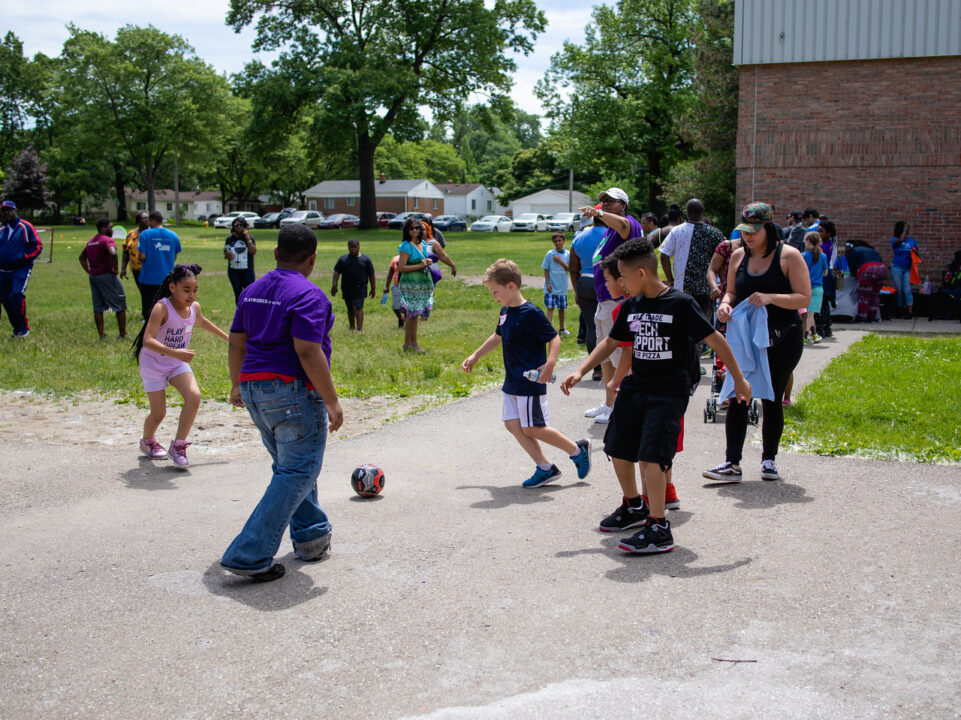
How Farmington Public Schools and Playworks Michigan used playground data and hands-on training to reduce conflict, build staff confidence, and strengthen school culture from the ground up.
About Farmington Public Schools
 Located in Southeast Michigan, Farmington Public Schools serves more than 9,000 students across the communities of Farmington, Farmington Hills, and a portion of West Bloomfield.
Location: Farmington, MI
Students served: 9,000 (3,500 elementary students)
Number of schools: 16 (9 elementary schools)
Grade levels: K – 8 grade
Was the ball out of bounds or in? Whose turn was it? Did the shot count before the bell rang? When left unresolved, everyday playground disagreements like these often follow students back into the classroom.
In Farmington Public Schools, that pattern was hard to miss. Conflicts that began at recess were resurfacing during instructional time, and teachers were watching students struggle to communicate, problem solve, or work through disagreement without adult intervention.
To help find a solution, Farmington Public Schools partnered with Playworks Michigan. The partnership worked on two levels at once, providing students with the conflict resolution skills they needed to handle disagreements independently, while also training staff on how to recognize those moments, reinforce the strategies, and create the conditions for students to use them on the playground, in the classroom, and throughout the school day.
The partnership extended beyond individual schools. Throughout the year, Playworks Michigan’s Executive Director, Program Director, and Regional Partnership Manager met monthly with Farmington’s superintendent and assistant superintendent. Together, they reviewed playground observations collected through Playworks’ Great Recess Framework, survey results, and feedback from participating schools. These conversations helped both teams celebrate successes, identify opportunities for improvement, adjust support, and ensure the partnership remained aligned with the district’s goals. Just as importantly, the meetings created an ongoing value story grounded in data and the experiences of students and staff.
“The coaching model is absolutely the best that I have seen. I do, we do, and then we do together. That gradual release is what teachers do every day in the classroom. That model is just necessary in this program, and when I talk with all the other elementary principals, the coaching has to continue because that is the difference.”
– Rhonda Henry, Assistant Superintendent of Innovation & Strategic Initiatives, Farmington Public Schools
How It Happened
 Skills that stick
Students learned how to welcome others into a game, navigate disagreements, and step into leadership roles as Junior Coaches who helped lead games and activities with younger students. Most importantly, these skills were not limited to recess and carried into classrooms, hallways, and beyond.

Coaching adults as partners
The Playworks team worked alongside recess supervisors and school staff throughout the year to support their growth and professional development. Using the Great Recess Framework as a guide, Playworks staff observed recess at each school, collected data on safety, engagement, and student participation, and brought those findings back to district leaders in a format that was practical and actionable. Staff observed, co-facilitated, then led independently, which built real capacity that outlasted each visit and continued to grow even when Playworks team members weren’t on site.

Play as a shared language
By bringing play into staff meetings and classrooms through brain-break games, Playworks created a common framework that connected students and adults across the entire school day.
Three Areas of Transformation
Reduction in behavior referrals
Playworks staff introduced conflict resolution skills and welcoming behaviors on the playground. Students learned how to invite others into a game and navigate disagreements before they escalated. Eventually, these skills started showing up in classrooms and hallways too.
Building staff confidence
Through a gradual release model, “I do, we do, you do,” the Playworks team built lasting confidence among playground staff and teachers to lead play on their own, not just while Playworks was present. Regular check-ins with district leadership ensured that the tools being introduced were having an impact and that staff had the support they needed to keep using them independently between visits.
A school-wide shift in culture
Members of the Playworks team attended staff meetings and taught brain-break games for classrooms, creating a shared language of play across the entire building. Play stopped being something that happened only at recess and became part of how the school connected.
“Playworks helps students learn games in a safe and supportive classroom environment first, and then bring those experiences to recess where they can confidently play with their peers.”
– Deb Amos, Assistant Principal, Hillside Elementary, Farmington Public Schools
Stewarding a district-wide partnership
The success of the Farmington partnership was shaped not only by what happened in schools, but also by how Playworks and district leaders worked together throughout the year.
Maintain Executive-Level Alignment
Monthly meetings brought Playworks regional leadership together with Farmington’s superintendent and assistant superintendent. Rather than waiting until renewal season to discuss the partnership, the teams reviewed data, school experiences, successes, and areas for improvement throughout the year. This allowed Playworks to respond to emerging needs while helping district leaders see the partnership’s value as it developed.
Engage the Broader School Community
Playworks also presented at a districtwide PTO leadership meeting, where parents and community members experienced a Playworks game and learned more about what kids were experiencing at school. Parents shared stories about the positive effect Playworks was having on their children and expressed their desire for the partnership to continue. This engagement expanded awareness beyond school and district administrators and helped build a broader group of Playworks champions.
Plan for Sustainability Early
As support for Playworks grew, district and PTO leaders began opening their networks to help sustain the partnership. They shared information about corporate partners that had previously supported Farmington schools through funding, volunteerism, or in-kind contributions, creating new opportunities for long-term community investment.
Because funding and sustainability were discussed throughout the year, Playworks knew by April that the district had identified resources to continue serving all nine elementary schools. The renewed districtwide partnership uses a combination of TeamUp and Pro professional development: some schools receive direct onsite TeamUp support, while others are reached by equipping their staff through Playworks training. As a result, every Farmington elementary school continues to benefit from Playworks.
Outcomes and Impact
 Fewer behavior referrals, with students better equipped to resolve small conflicts before they escalated to staff.
 Staff confidence grew, with recess supervisors and teachers leading play independently between Playworks visits.
 Students returned to class ready to learn, with less conflict carrying over from outside into instructional time.
 District leadership stayed informed, with regular data reviews that gave administrators a clear picture of where recess was thriving and where staff needed additional support.
 Districtwide reach was sustained, with all nine elementary schools continuing through a combination of TeamUp services and Pro professional development.
 A broader network of champions emerged, as district leaders, school staff, PTO leaders, parents, and community partners became invested in sustaining Playworks.
The changes Farmington staff observed are backed by data. Across Playworks Michigan partner schools, 94% of educators agree that Playworks helps students build positive relationships with their peers, and 90% agree that it helps students learn to cooperate.
The impact also extends into the classroom. Independent research from Mathematica found that teachers in Playworks schools recover the equivalent of two weeks of instructional time each year, giving them more time to focus on teaching and learning. When students have more opportunities to play, connect, and cooperate, everyone gets more out of the school day.
Contact us to learn how you can bring Playworks to your school or site