Keep Playing Week 37
Game of the Week: Secret Agent
This week Playworks is featuring a game where students will “sneak to success” while practicing Understanding Consequences.
Skill Focus:
Understanding Consequences: Considering what will happen after you take a particular action and whether the outcome of your action will positively or negatively affect you and those around you.
Play In-Person
Play Virtually
Simplified Game Instructions
# of people to play: 3+
Best for ages: 6+
Setup/Teaching Time: 5 minutes
Equipment needed: boundary markers, object for players to capture (ex: cone, small ball, bean bag, rolled up paper, etc)
Goal: to move carefully and quietly to try and reach the Secret Agent’s special object without getting caught.
Before You Start:
- Talk to players about what Secret Agents and Spies do: they move carefully and quietly to try to accomplish their goal.
- Clearly define the playing area with a designated starting point for Secret Agent and Spies.
- Remind players to move carefully in the game boundaries.
How to Play:
- The facilitator will select one player to be the “Secret Agent.”
- The Secret Agent will go to the other side of the play area from the spies. They will place a small ball or other small object in front of them somewhere on the ground.
- All other players will be the Spies. The Spies will all start at the same starting line opposite of the Secret Agent.
- At the beginning of each round, the Secret Agent will turn around and have their back towards the spies and yell “Access Agent.”
- When the spies hear the secret agent yell “access agent” they will begin to move towards the Secret Agent’s “object” to try and capture it. Be sure to give the students a type of movement they should be using! (ie Tip Toe, skipping, heel to toe walk, etc)
- At any moment the Secret Agent can turn around and shout “Stop!” and the Spies must stop moving immediately.
- Any spy caught moving once the Secret Agent turns around must go back to the starting line and join in again when the Secret Agent turns back around.
- The first Spy to touch the object becomes the new Secret Agent for the next game.
Game Debrief
- What risks did you take while playing this game?
- How did you decide when to take a big risk, a smaller risk or even no risk at all? What influenced your decision?
- We all take risks every day in lots of different parts of our lives. What are examples of other risks you take in your life? When could risk-taking be a good thing?
Game Modifications
Age Group Modifications
- For younger students: adjust how they move; skipping, hopping, backwards, heel-to-toe to increase or decrease the level of difficulty.
- For older students: try increasing the difficulty by having spies who are caught moving freeze and turn into Agent Allies. Agent Allies must keep their feet planted, but can tag and freeze any remaining spies that come within their reach.
Challenge Ideas
- Set up multiple objects or pieces of paper for spies to select once they reach the Secret Agent, and introduce a logic puzzle that they must solve to select the correct one.
- Example: Secret Agent has 7 objects/cards representing the days of the week and the spies must select the correct day of the week without being detected by the Secret Agent.
- Puzzle: You meet a lion and a unicorn in the forest. The lion lies every Monday, Tuesday and Wednesday and the other days he speaks the truth. The unicorn lies on Thursdays, Fridays and Saturdays, and the other days of the week he speaks the truth. The lion tells you, “Yesterday I was lying”. The unicorn says “So was I”. What day is it?
- Answer: Thursday. The only day they both tell the truth is Sunday; but today can’t be Sunday because the lion also tells the truth on Saturday (yesterday). Going day by day, the only day one of them is lying and one of them is telling the truth with those two statements is Thursday.
Academic Applications
- When a spy is caught, have them complete a flashcard question to get back in the game.
- When a spy makes it to the Secret Agent’s object, make a final flashcard question required to win the round.
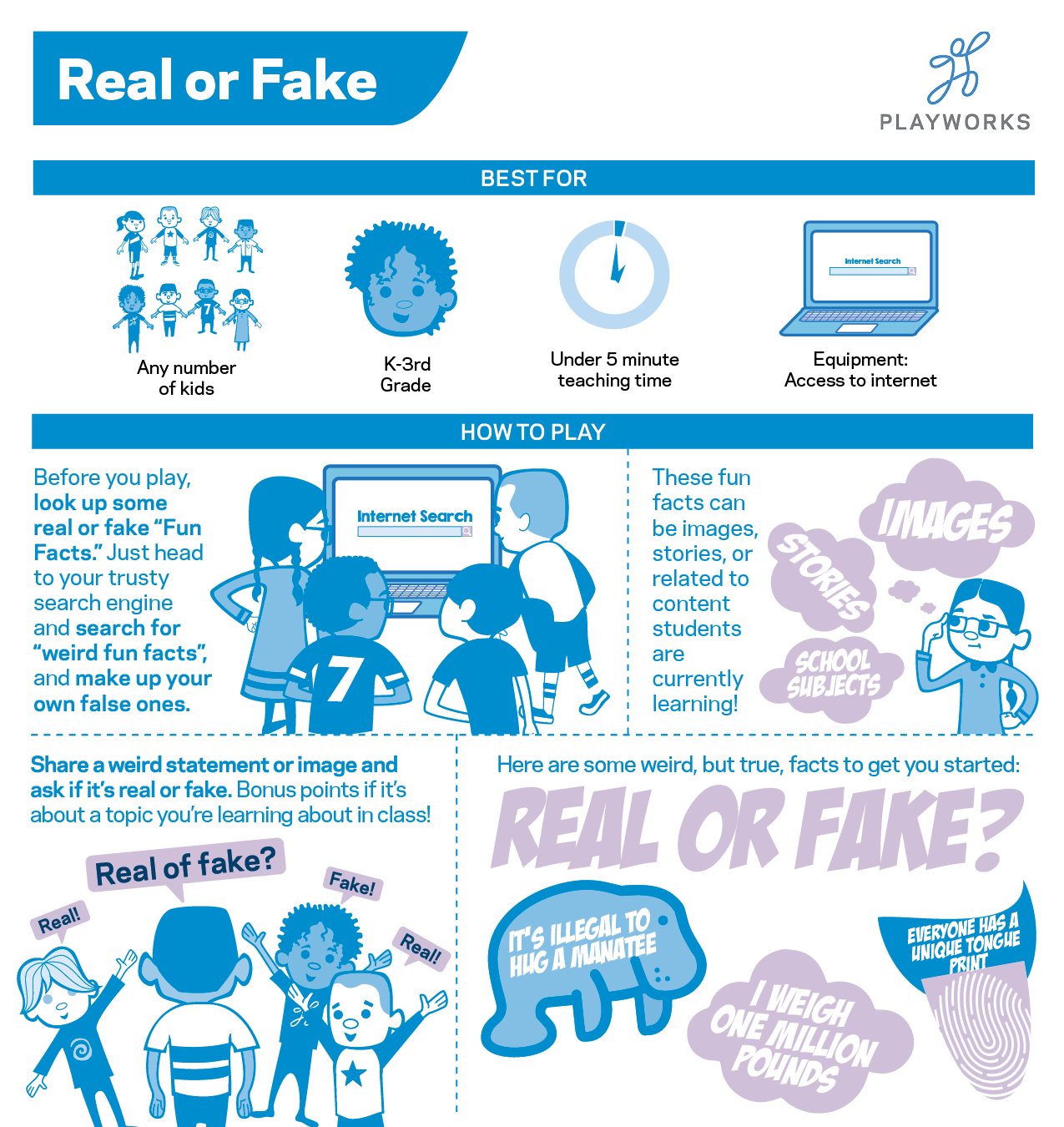
Brain Break: Real or Fake
Before You Start
- Look up some real or fake “Fun Facts”
- These can be images, stories, or related to content students are currently learning!
How to Play
- Share a weird statement or image and ask if it’s real or fake. Bonus points if it’s about a topic you’re learning about in class!
- Just head to your trusty search engine and search for “Weird fun facts”, and make up your own false ones.
- Here are some weird, but true, facts to get you started:
- It’s illegal to hug a manatee.
- Everyone has a unique tongue print (like a fingerprint).
- A single cloud can weigh more than 1 million pounds.
- If you would like to play this game with more movement here are some modifications:
- Have students line up in a straight line shoulder to shoulder with some physical space allowing for movement.
- When you are reading the fun facts, if the fact is “True” then students must take 2 steps forward.
- If the fun fact is false, students stay where they are.
- If a student does not answer correctly, they must take one step backwards and have students do a movement like five air squats or five jumping jacks.
- Goal of the game is to make it to the other side of the classroom by answering the fun facts correctly.
- Encourage students to work together, be honest, and have fun!
Additional Resources
Sample School Community Announcement
For the month of June we will continue focusing on the theme of responsible decision making. Responsible decision making means understanding all aspects of a decision and its consequences before making a choice.
This week, we will move on to the understanding consequences stage of responsible decision making. Being able to consider what will happen after you take a particular action and whether the outcome of your action will positively or negatively affect you and those around you is a big part of being able to make responsible decisions. While playing Secret Agent, players are presented with opportunities to take risks to reach a goal object. But how will they know when to move and when to freeze? What information can they use to prevent getting sent back to the start? Help them find out if the risk is worth the reward.
Teach students to play in class, and then empower them to lead the game and teach others!
Core Recess Game
In addition to our Keep Playing Game of the Week, we’re sharing bi-weekly Core Recess Games that will help kids be active, practice leadership, maximize recess time, and have fun.
This week’s game is CAT & MOUSE JUMPROPE!
Return to the Keep Playing Homepage for archives of past weeks and other helpful resources.