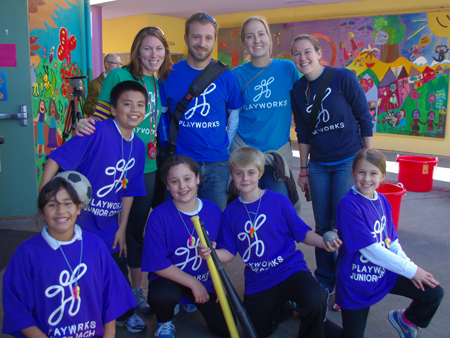
I talk to a lot of parents. It is, I feel, a necessary aspect of my role as a Program Coordinator. Part of it has to do with the fact that the Playworks program is a multifaceted one: I’m currently teaching several enrichment classes during the day, running an after-school program four days a week, managing a group of fourth and fifth grade Junior Coaches, and recruiting for a girl’s basketball team – all of which afford me plenty of opportunities to log significant face time with nearly every student in the school. It should come as no surprise, then, that I find myself frequently engaged in conversations with parents – some of whom have students who are enrolled in my after-school program or play for one or another of my teams. But there are also those who have heard about me from their son or daughter and are simply interested in Playworks’ role within the school community in general and, often, with regards to the development of their child(ren) specifically.
I’ve had a number of these conversations over the past few weeks. One parent, a mother of two who occasionally volunteers to help in the playground during lunch time, chatted to me about how she views healthy, structured play as a necessary aspect of her children’s development – even going so far as to say that she feels the benefits of play are just as important as the learning that goes on in the classroom. We spoke about how the two are necessarily related: how, from a child’s perspective, recess can be among the most significant aspects of the day. “If a kid has a positive experience at recess, it makes it that much easier for that kid to transition back to the classroom,” the mother said. “And if they can take the confidence they gained during a game of kickball or four-square and apply that to their reading or math, the effect is that they will be better learners.”
Yet the benefits extend beyond the classroom. Recess and lunch times provide great occasions for students to grow socially as well. “The kids want to play,” said another mother. “For them it’s all about the game. But then there are all these great social things that happen, too. Students who are the same grade but in different classrooms during the day get to connect with their peers.” This is especially noteworthy. These times of intersection provide not only chances for exercise, but also a myriad of opportunities for children to think strategically, practice cooperation, and resolve conflicts – all skills that they can carry with them long after they leave the playground.
-Coach Alex (Sherman Elementary)