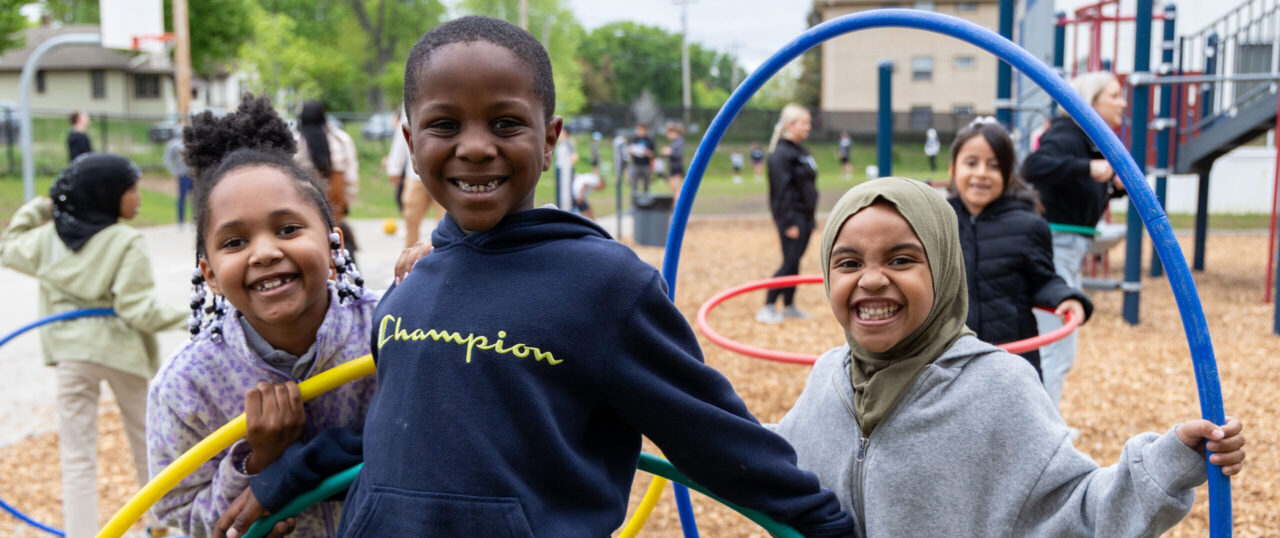
School Climate Isn’t Built in Assemblies. It’s Built in the Moments Between Classes.
The hallways. The cafeteria. The playground. That’s where students decide if this school is a place they belong.
The Reality
Your strategic plan says “improve school climate.” Your state survey measures it. You’ve invested in PBIS, MTSS, maybe an SEL curriculum. The scores aren’t moving.
Here’s what most climate initiatives miss: the unstructured parts of the day. Recess, lunch, transitions. The moments where students experience your school’s actual culture, not the one on the poster in the front office.
The Shift
Playworks doesn’t replace PBIS or compete with your SEL curriculum. It fills the gap they can’t reach: the 45-60 minutes a day when students are in shared spaces without classroom structure. Principals tell us it becomes how their school operates, not another initiative layered on top.
The Research Behind Play and School Climate
A summary of 30 years of evidence connecting structured play to measurable improvements in school culture, behavior, and student belonging. Includes findings from Stanford, Mathematica, and the Journal of School Health.
43%
reduction in bullying behaviors

PBIS Tier 1
aligns with universal prevention framework

34%
reduction in transition time from recess to learning
Contact Us to Bring Playworks to your School or Organization
“Everything we’re doing with Playworks fits with what we’re doing in terms of PBIS and our social emotional supports, and everything aligns. It’s always important to revisit the why.” — Principal
“After partnering with Playworks for nine years in two different schools, I can say definitively that the program has a direct impact on the culture of any school.” — Principal
See How Playworks Fits with What You’re Already Doing.
A quick conversation can help you see where structured play fills the gaps in your current approach, whether that’s PBIS, MTSS, or something else.
Frequently Asked Questions
Yes. Playworks operates as a Tier 1 universal prevention strategy within PBIS and MTSS frameworks. RAND has reviewed Playworks in this context, and the program aligns with CASEL’s competency framework for social-emotional development. Schools using Playworks alongside PBIS report that recess becomes the practice field for the expectations students learn in classrooms. It doesn’t replace your existing framework. It extends it into the unstructured time where most behavior incidents actually happen.
School climate is shaped most during the moments with the least adult structure: recess, lunch, hallways, transitions. These are the parts of the day where students experience whether the school’s values are real or just words on a poster. When recess runs on consistent expectations, inclusion, and skilled adult facilitation, that culture carries back into classrooms. Stanford research documented a 43% reduction in bullying in Playworks schools, and Mathematica found 34% less transition time lost after recess.
Playworks tracks behavior referrals from recess, transition time from recess to learning, student inclusion and participation rates, and school climate indicators aligned to state survey frameworks. Partner schools receive access to regional outcome dashboards with comparison data. We also conduct an annual partner survey measuring educator-reported outcomes across behavior, engagement, and school culture.
Absolutely. Most districts start with one or two buildings, measure results, and expand from there. Playworks offers coaching, training, and digital tools that scale at different price points. A principal can try the free Game Guide this week, get staff trained through PRO this quarter, and add onsite coaching next year.
30 years. 6,000+ schools. 5.3 million students. 80% Title I.
Backed by research from Stanford, Mathematica, and UC Berkeley. Playworks is a 501(c)(3) nonprofit.